The courage to start

How AI helps creativity begin
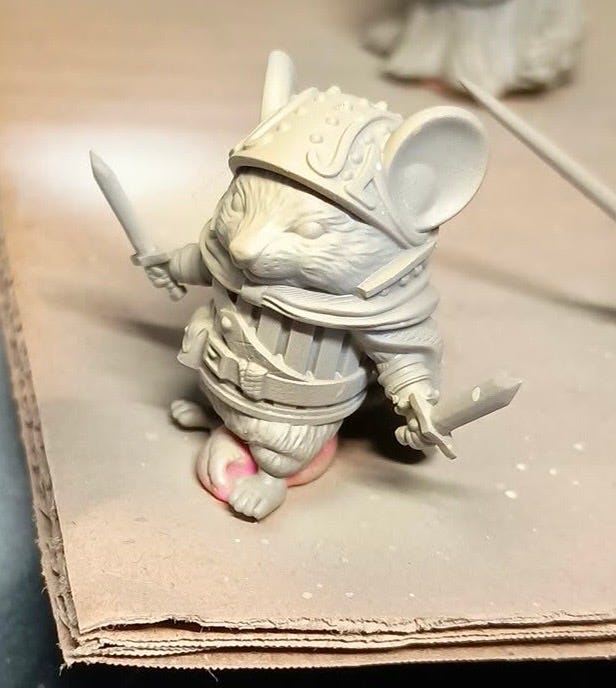
A small mouse sat on my desk.
Less than two inches tall (5 cm), covered in matte grey primer and potential.
And oddly enough, that tiny figure would teach me something important about creativity and AI.
He was holding two daggers, wearing a tiny cloak and armour, and staring up at me with the quiet patience of an unpainted miniature.
I had some paints.
I had some brushes.
I had some skill.
And still I hesitated.
Anyone who paints miniatures, writes stories, or begins any kind of creative project knows this moment. The hardest part isn’t usually the work.
It’s the start.
The first brush stroke that might ruin the model.
The first decision that might turn out wrong.
The blank space where something should exist.
Recently, though, I noticed something surprising.
AI isn’t doing the work for me.
It’s helping me do the work.
And more importantly, it’s giving me the courage to begin it.
The Real Barrier to Creativity
When people talk about AI and creativity, the conversation often assumes something strange.
That creativity is mostly about producing things.
Write the words.
Paint the miniature.
Draw the image.
But most creative people know the real difficulty appears much earlier.
The problem is crossing the gap between idea and action.
That gap fills up quickly with questions:
What colours should I use?
What if I ruin it?
What should the first step be?
That uncertainty is where projects stall.
Used well, AI does something subtle but powerful.
It doesn’t remove creativity.
It shrinks the distance between thinking about a project and beginning it.
The Mouse on My Desk
The mouse miniature became a perfect example.
Instead of staring at it for an hour wondering what to do, we used AI to explore possibilities.
Colour schemes.
Material choices.
Painting order.
Within minutes we had a clear plan.
Warm tan fur.
A bright red cloak.
Silver armour.
Brown leather.
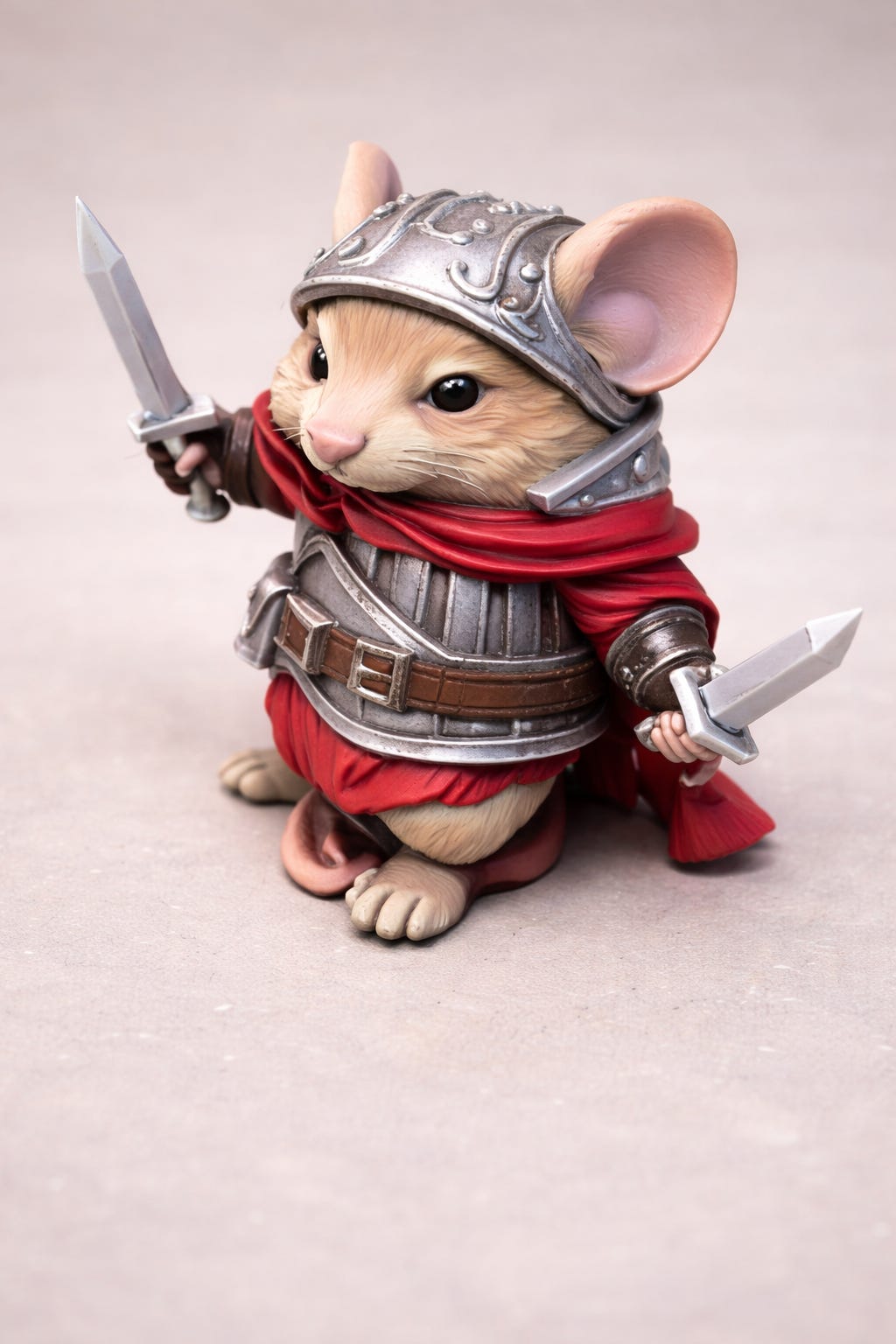
A step-by-step sequence for painting the different areas.
The miniature was still blank.
But it no longer felt like a risk.
It felt like a project already in motion.
AI didn’t choose the colour scheme for me.
It didn’t paint the miniature.
The brush was still mine.
The judgement was still mine.
The final result would depend entirely on human skill.
What changed was something much simpler.
The fear of starting had quietly disappeared.
Three Ways People Use AI
Through experiences like this, I’ve started thinking about creativity with AI in three roles.
Operator
The operator asks AI to produce something.
“Give me colour schemes.”
“Generate a character.”
“Write a story.”
Most people start here.
Director
The director shapes the exploration.
They guide the AI, test ideas, refine options, and evaluate results.
Instead of asking for one answer, they explore possibilities.
That’s what we were doing with the mouse miniature — testing palettes and painting approaches until something felt right.
Architect
The architect designs systems that produce creativity.
Instead of generating one idea at a time, they build structures that generate many ideas.
Different prompts.
Different constraints.
Different paths for exploration.
In this role, creativity moves away from producing individual outputs and toward designing environments where creativity can flourish.
Where Creativity Actually Lives
What this shift reveals is something important.
AI doesn’t eliminate creativity.
It moves it.
Instead of spending all our effort producing raw output, we spend more time:
framing problems
exploring possibilities
making aesthetic judgments
designing systems
And, crucially, starting more projects.
Because the psychological cost of beginning is suddenly much lower.
AI as a Creative Mentor
The best way I’ve found to describe this relationship is simple.
AI acts like a creative mentor.
Not someone who does the work for you.
Someone who helps you get unstuck.
A mentor might say:
Try these colours.
Start with this approach.
Break the problem down into steps.
You still do the work.
But the path forward becomes visible.
The Courage to Start
That mouse miniature on my desk is now halfway painted.
The cloak is bright red.
The armour catches the light.
The tiny daggers look ready for trouble.
None of that came from AI.
AI isn’t doing the work for me. It’s helping me do the work.
The brush was still mine.
The judgement was still mine.
It didn’t choose the colour scheme for me.
But the moment that mattered most — the moment where the brush touched the miniature for the first time — happened because the fear of beginning had disappeared.
The mouse had always had the potential.
AI simply helped me find the courage to begin.
If only more used this tool in the constructive way you outlined.
AI is best as the helper, an advisor. As you mentioned, getting people "unstuck". It can take preferences into account and help explore possibilities. Assist in someone deciding what they do (and don't) want.
Too many seem intent on using it as an authority or the creator of the end product. The final authority in making decisions on what is, and is not permissible. The author and final editor of reports and stories that other people are expected to read. The cameraman, producer and director of fantasy that is distributed under the guise of reality.
AI is here to stay, like it or not. In this digital age, when used correctly, it's a tool too useful to ignore. Maybe there is also a way to curtail it's misuse. Unfortunately, no ideas on this come to mind.